
For decades, public health campaigns treated sugar as an innocent luxury—an indulgence that added empty calories to our diet, but required nothing more than basic restraint and extra exercise to burn off. However, groundbreaking nutritional science and neurobiology are dismantling this "calorie is a calorie" paradigm. Emerging evidence suggests that added sugar, in the quantities consumed today, operates not merely as a source of excess energy, but as a dietary toxin driving major modern epidemics, including heart disease, type 2 diabetes, hypertension, and even cancer.
This paradigm shift has sparked a growing anti-sugar movement led by researchers who argue that our current relationship with sugar closely mirrors our historical relationship with tobacco. When an addictive, ubiquitous substance drives widespread chronic disease and public health failure, individual willpower is no longer enough. The question is no longer whether sugar is bad for us, but whether it belongs in the same regulatory category as alcohol and cigarettes.
1. The War on Sugar: From Dietary Treat to Public Health Crisis
The crusade against added sugar gained mainstream momentum through Dr. Robert Lustig, a pediatric endocrinologist at the University of California, San Francisco (UCSF). Driven by the alarming rise in chronic metabolic sickness and obesity among children, Dr. Lustig co-authored scientific research and delivered a viral lecture titled Sugar: The Bitter Truth, launching a national debate on metabolic toxicity.
Dr. Lustig asserts that modern sugar consumption has plunged society into an unprecedented public health crisis. Rather than viewing obesity and metabolic illness as moral failures of willpower, his research points to added sugars as the primary driver of preventable chronic disease.
"I believe sugar is toxic. Consumption of added sugars has plunged America into a public health crisis... 75% of chronic disease is preventable."
— Dr. Robert Lustig, Pediatric Endocrinologist, UCSF
The core issue lies in the sheer volume of sugar integrated into the modern food supply. While table sugar (sucrose) and high-fructose corn syrup (HFCS) are often debated, Dr. Lustig notes that both sweeteners are functionally identical and equally harmful. Both consist of roughly equal parts glucose and fructose. Fructose provides the sweet taste that human biology is evolutionarily wired to seek out. Historically, humans ingested fructose in small quantities through whole fruits, where fiber slowed digestion and limited total intake. Today, industrial processing removes fiber and concentrates fructose into thousands of products, leading the average American to consume approximately 130 pounds of added sugar per year—the equivalent of one-third of a pound every single day.
2. A Calorie Is Not a Calorie: The Metabolic Proof
For decades, conventional nutritional wisdom relied on the energy balance model: a calorie from sugar is identical to a calorie from broccoli, fat, or protein. To challenge this assumption, Dr. Kimber Stanhope, a nutritional biologist at the University of California, Davis, conducted a rigorous five-year clinical trial.
To eliminate confounding variables, research subjects were placed under 24-hour lockdown in a hospital wing for weeks at a time. Every morsel of food was weighed, prepared, and monitored. After establishing baseline measurements on a low-sugar diet, researchers replaced 25% of the subjects' daily calories with drinks sweetened with high-fructose corn syrup. Blood samples drawn every 30 minutes revealed rapid and dangerous metabolic shifts within just two weeks.
Key Clinical Findings from the UC Davis Lockdown Study
| Metabolic Indicator | Baseline Condition | Post-Sugar Intervention (14 Days) | Health Implication |
|---|---|---|---|
| Circulating Small Dense LDL | Normal range | Markedly elevated | Particle lodging in vessel walls forming arterial plaque |
| Hepatic Lipogenesis | Balanced liver processing | Fructose overload converted directly to fat | Accumulation of liver fat and release of lipid particles into blood |
| Cardiovascular Risk Factors | Low baseline risk | Significant increase across all subjects | Heightened long-term risk of heart attack and stroke |
Dr. Stanhope's findings directly refuted the idea that all calories affect the body equally. When the liver is flooded with high doses of liquid fructose, it cannot process the load through normal metabolic pathways. Instead, it converts the excess fructose directly into fat. Some of this fat escapes into the bloodstream as small, dense low-density lipoprotein (LDL) particles—the specific type of cholesterol known to lodge in arterial walls, build plaque, and precipitate heart attacks.
3. Feeding the Disease: Cardiovascular Damage and Cancer Growth
The physiological impact of excess sugar extends beyond cardiovascular damage into oncology. Dr. Lewis Cantley, a Harvard professor and head of the Beth Israel Deaconess Cancer Center, has investigated the direct molecular link between sugar intake and tumor progression.
When we digest sugar, the pancreas responds with a rapid surge of the hormone insulin to clear glucose from the bloodstream. While healthy muscle and fat tissues utilize insulin to absorb energy, Dr. Cantley's research revealed that approximately one-third of common human cancers—including breast and colon cancers—express high levels of insulin receptors on their cell surfaces.
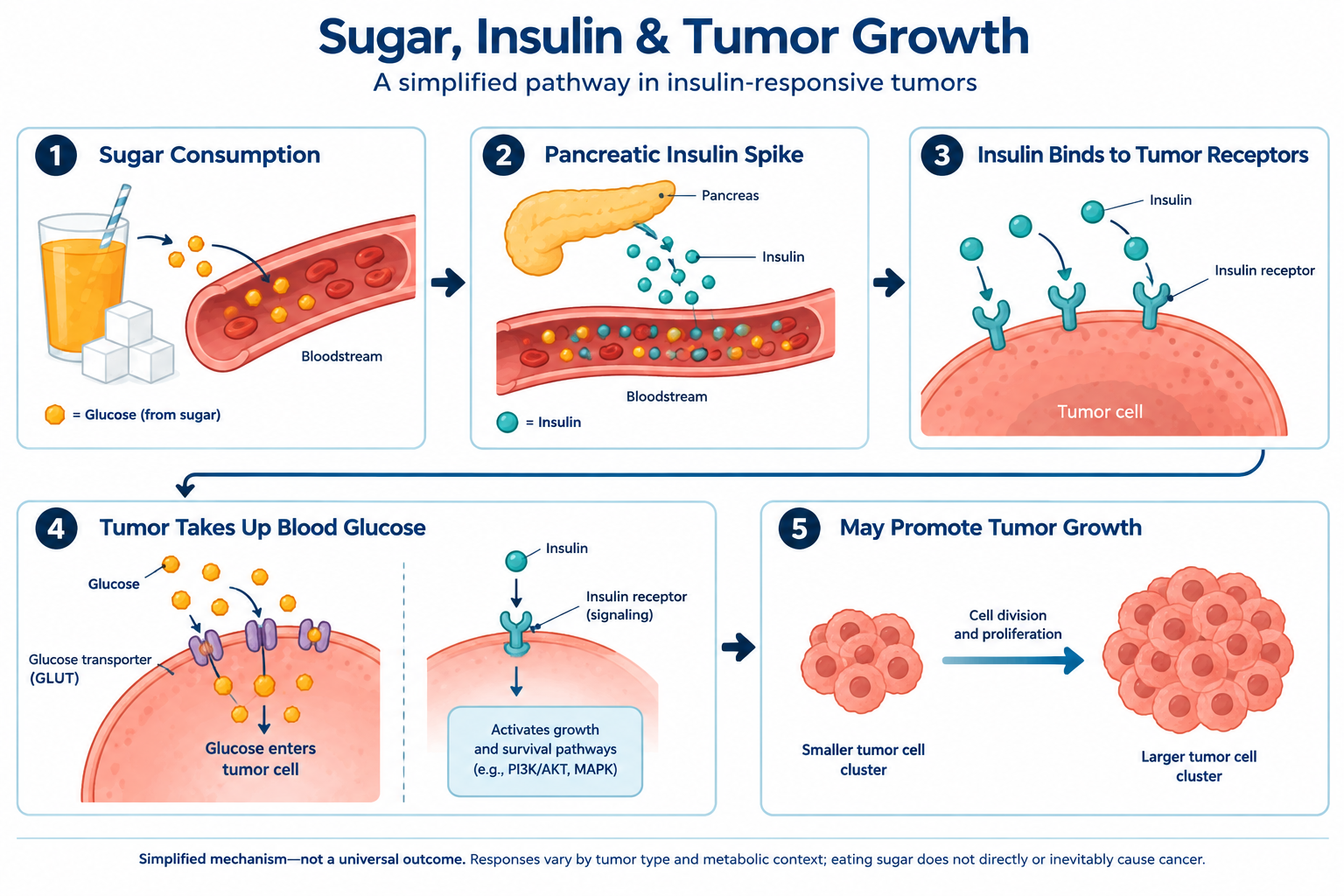
These insulin receptors allow cancer cells to hijack circulating glucose. While normal cells absorb energy as needed, insulin-stimulated tumors aggressively pull glucose out of the bloodstream to fuel rapid growth and division. Consequently, chronic insulin spikes caused by high-sugar diets create an ideal biochemical environment for tumor proliferation. Dr. Cantley's guidance is straightforward: minimizing sugar intake is a critical preventive measure against cancer development.
4. Hooked on Sweetness: Fructose, Dopamine, and Brain Rewiring
If added sugar causes severe cardiovascular and metabolic harm, why is it so difficult for individuals to reduce their intake? The answer lies in neurobiology. Dr. Eric Stice, a neuroscientist at the Oregon Research Institute, utilized functional Magnetic Resonance Imaging (fMRI) to observe real-time brain activity in response to sugar consumption.
When a participant receives a sip of a sugary beverage inside an fMRI scanner, the brain's reward centers light up instantly. The sweet taste triggers a surge of dopamine—the exact same neurochemical pathway activated by addictive substances such as alcohol and cocaine.
The Addiction and Tolerance Cycle
- Initial Consumption: Sweet taste triggers dopamine release in the nucleus accumbens, creating a powerful sensation of pleasure.
- Repeated Exposure: High-frequency intake of sweetened foods overstimulates dopamine receptors.
- Neuroadaptation: The brain down-regulates its reward response to protect against constant overstimulation, blunting the euphoric effect.
- Tolerance & Craving: Individuals must consume progressively larger quantities of sugar to achieve the same level of satisfaction, driving compulsive overeating.
This neurobiological feedback loop demonstrates that sugar is not merely a dietary choice, but a habit-forming substance capable of altering brain chemistry and driving tolerance.
5. How We Got Here: The Low-Fat Myth and Corporate Pushback
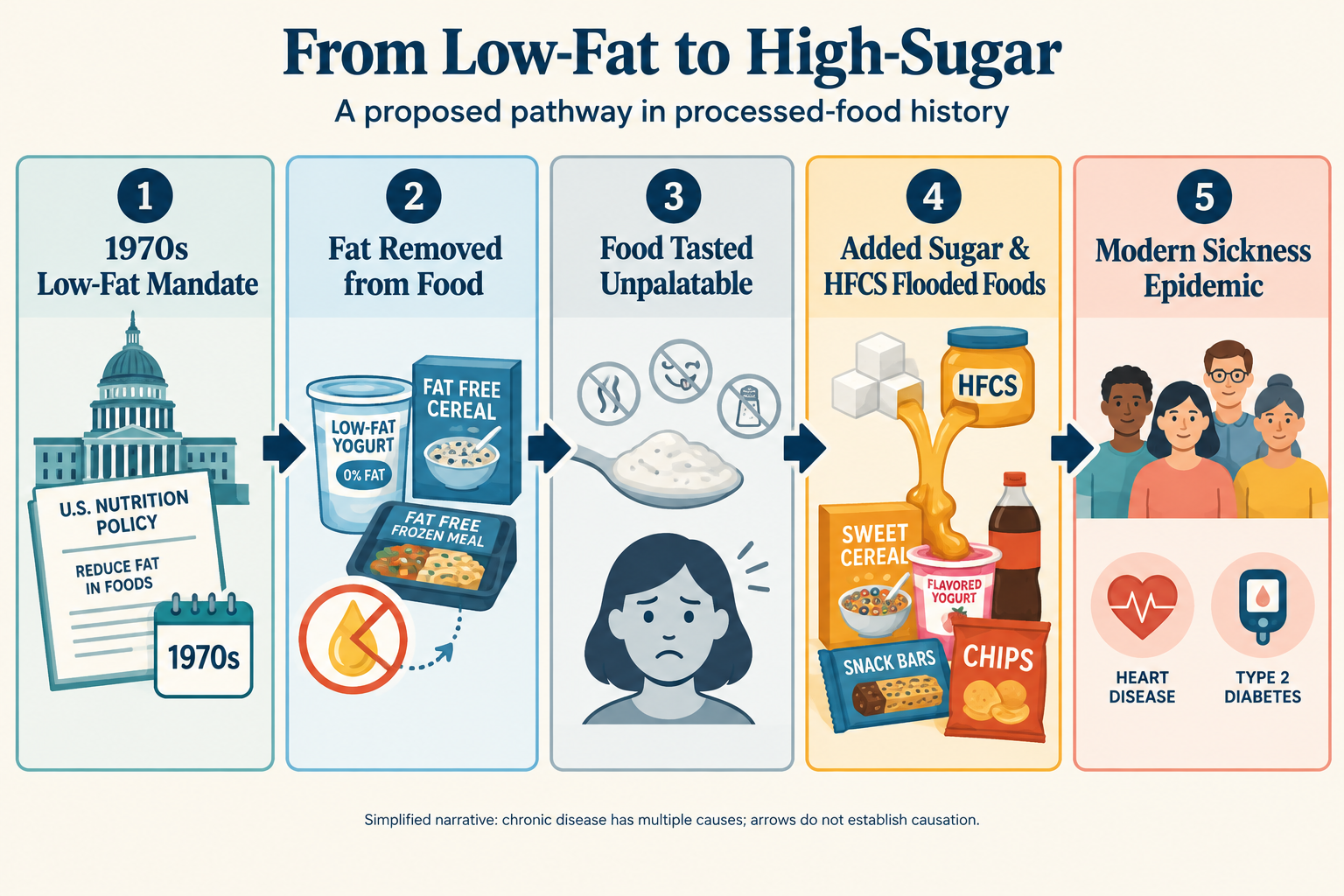
The current public health predicament is rooted in the dietary shifts of the late 20th century. In the 1970s, a U.S. government commission recommended lowering dietary fat intake to combat heart disease. Food manufacturers complied by removing fat from processed foods. However, removing fat destroyed the palatability of products, leaving them tasting bland.
To restore flavor, the food industry replaced fat with added sugar and high-fructose corn syrup. Over the subsequent decades, while dietary fat intake dropped, rates of heart disease, metabolic syndrome, type 2 diabetes, and obesity surged dramatically.
The Industry Perspective
The sugar industry pushes back against the toxic label. Jim Simon, a representative speaking on behalf of the Sugar Association, contends that single ingredients should not be demonized. Industry representatives argue that nutritional science remains unsettled and advocate for a focus on total caloric balance and physical exercise rather than restricting specific food components.
However, clinical researchers argue that this defense mirrors early tobacco industry strategies—attributing health risks to broader lifestyle factors while downplaying the unique biological harm of their core product.
6. The Tobacco Analogy: Is It Time for Societal Intervention?
The comparison between sugar and cigarettes rests on three distinct pillars:
- Dose-Dependent Toxicity: Like tobacco, chronic sugar consumption directly damages organ systems independent of simple weight gain.
- Addiction and Tolerance: Like nicotine, sugar rewires brain reward pathways, leading to tolerance and compulsive consumption.
- Societal and Economic Burden: Like smoking-related illnesses, metabolic disease drains healthcare systems and burdens public resources.
To address this crisis, Dr. Lustig co-authored guidelines for the American Heart Association recommending strict daily limits on added sugar:
- Men: Maximum of 150 calories (approx. 9 teaspoons) per day.
- Women: Maximum of 100 calories (approx. 6 teaspoons) per day.
For context, a single 12-ounce can of soda contains more than 150 calories of added sugar, instantly exceeding the recommended daily limit for any adult.
Because added sugar is concealed in up to 75% of processed grocery items—including bread, pasta sauces, yogurt, and savory snacks—relying solely on individual consumer vigilance is insufficient. Dr. Lustig concludes that when a dietary substance causes widespread public health harm, society must transition from individual advice to structural intervention. Just as governments introduced age restrictions, taxation, and marketing controls on tobacco and alcohol, added sugar may soon require similar public policy measures to protect public health.